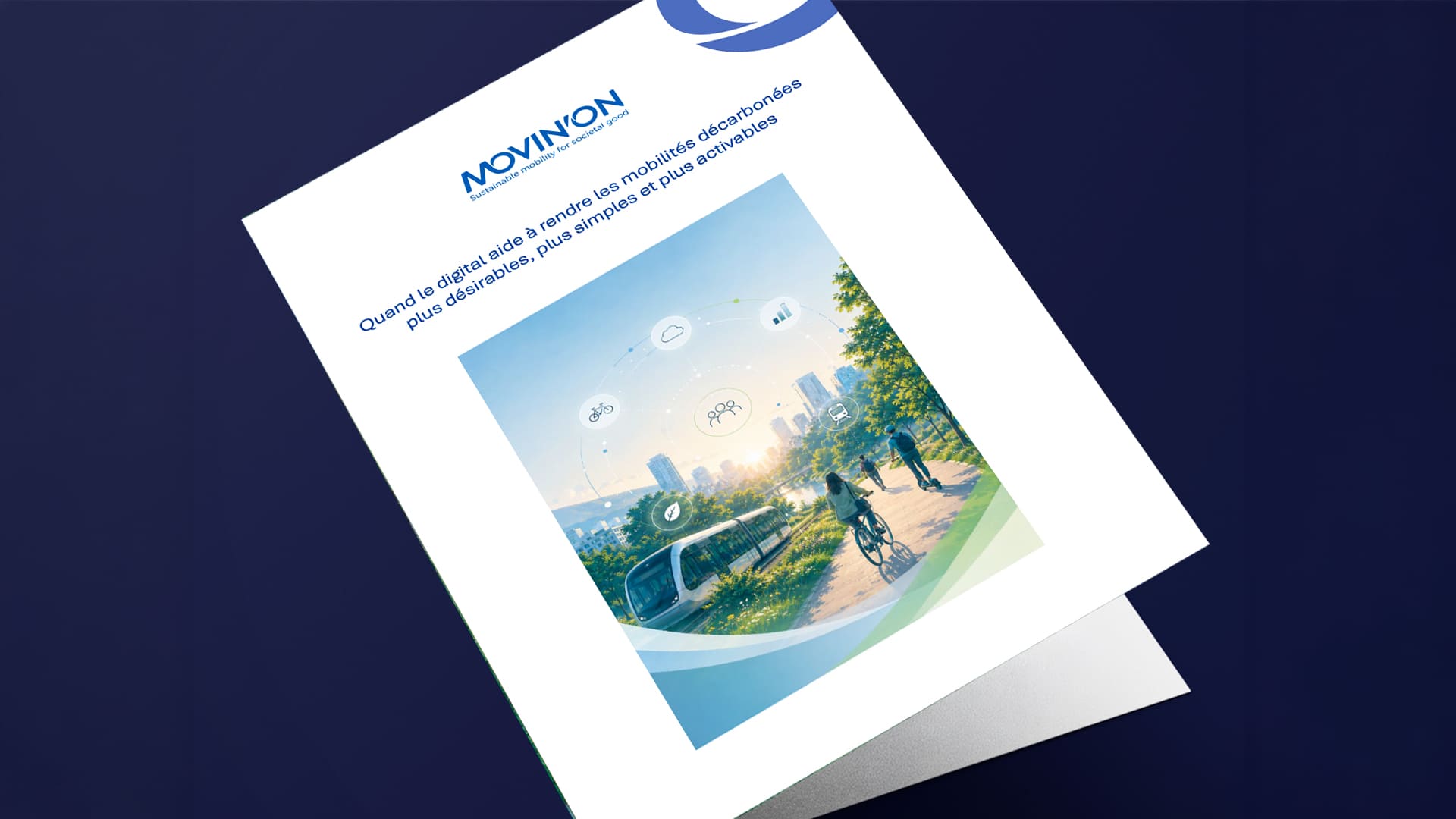
Today, the mobility challenge is not simply to provide alternatives to private cars. It is to coordinate, around the traveller, offers and services that already exist but remain too fragmented to deliver their full potential. Public transport, carpooling, cycling and intermodal travel: for users, these solutions still form a fragmented system that is difficult to understand and combine on a daily basis. In these conditions, the private car often continues to prevail—not because it is necessarily the best solution, but because it remains the easiest to organise.
Digital technology does not replace infrastructure or mobility services. But it can play a decisive role in connecting them: better coordinating available offers, making the tangible benefits of more sustainable mobility visible and supporting behaviour change more effectively. This is the idea behind “Software-Driven Mobility”: mobility better organised through data and software, serving travellers, businesses and local authorities.
Making the benefits of change tangible
People rarely change their habits for climate benefits alone. They change the way they travel when the personal advantages become clear: simplicity, comfort, reliability, useful time savings, lower costs and better health. Digital technology can make these benefits tangible by reducing the mental burden of making choices, adapting recommendations to real-life situations and giving everyone clear insight into what they stand to gain by changing their habits.
This position paper clarifies the role of software as a driver of coordination, adoption and scaling. It brings this role to life through a concrete use case: the Green Mobility Coach, an initial demonstrator developed on the basis of a feasibility study conducted with EFREI. By making travel habits more visible, alternatives easier to understand and the benefits of change more tangible, this lightweight tool paves the way for more sustainable and better-coordinated mobility, starting with commuting.
From initial pilots to the conditions for scaling
Employers, local authorities and insurers: several testing grounds are already emerging, each with its own needs in terms of understanding travel patterns, providing support and managing implementation. The challenge now is to create the conditions for scaling: interoperability, trust in data use, inclusion, a clear business model and value for every stakeholder. The next step is to test all of this in real-life conditions. This is where the role these tools can play in mobility, CSR and transition policies will be determined.
A reflection led by Allianz Partners, Capgemini, Michelin, Microsoft and SNCF, based on a shared conviction: digital technology gives mobility the means to become more useful, more sustainable and more human.