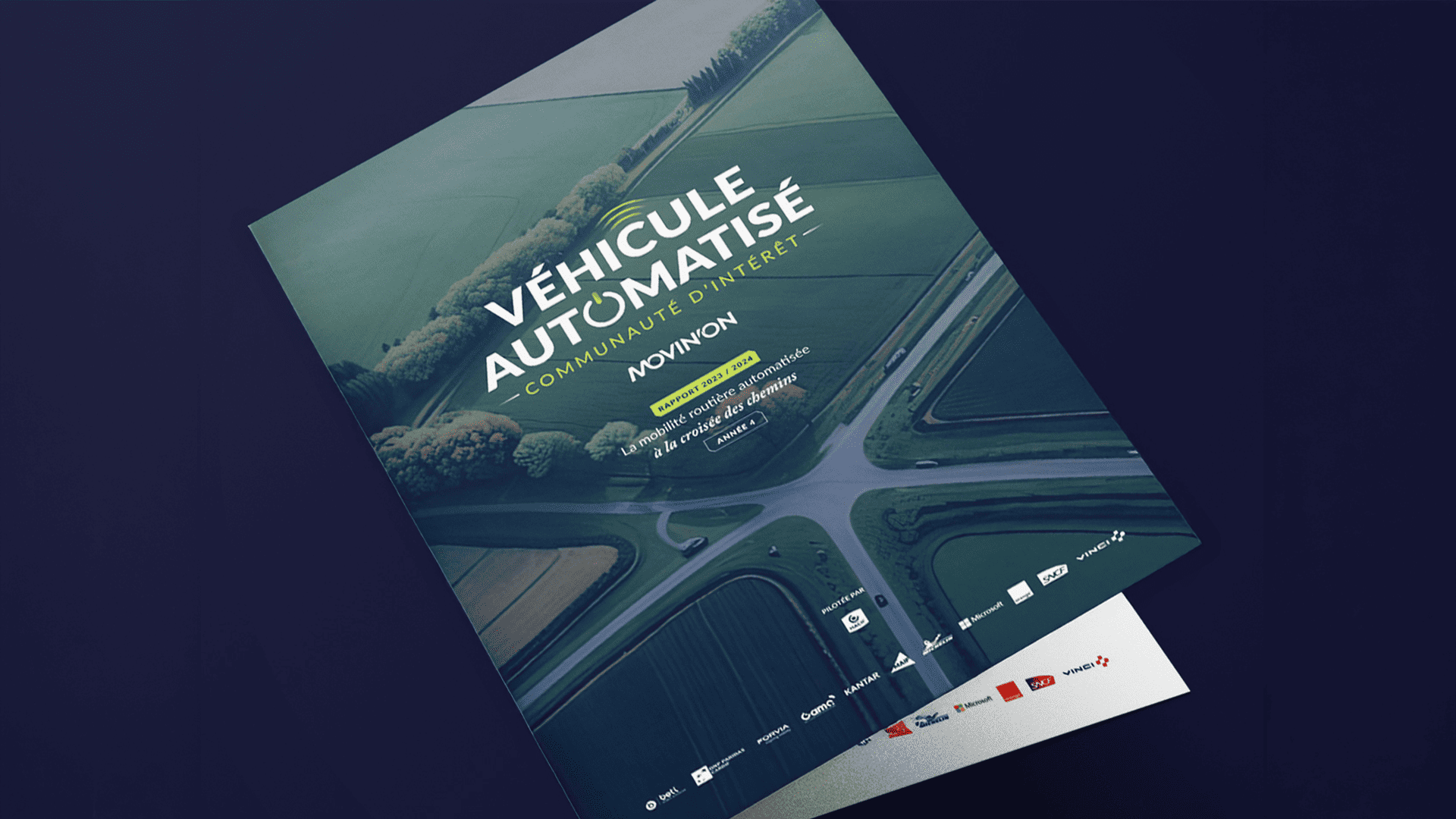
It now brings together 12 major companies working collectively through an open innovation approach: beti, BNP Paribas Cardif, Forvia, Gama, Kantar, Macif, Maif, Michelin, Microsoft, Orange, SNCF and Vinci.
The work is also supported by a Steering Committee made up of representatives from member companies (Yann Arnaud – Macif, Alexis Offergeld – Movin’On LAB), researchers and experts (Henriette Cornet – Automated Mobility Expert, Gérard Hernja – École de Conduite Française, Francis Demoz – Laboratoire de la Mobilité Inclusive), and political stakeholders (Damien Adam – Member of Parliament for Seine-Maritime, Frédéric Cuillerier – Mayor of Saint-Ay (Loiret) and Co-Chair of the AMF « Transports, mobilités, voirie » Commission). These seven members provide the Community with their perspective on the issue and help guide its work.
The Community focuses on a specific model: a shared automated shuttle that could help open up underserved areas, accelerate the environmental transition and make mobility easier for local communities, improving access to employment, education, healthcare and more. The aim is to support the emergence of more sustainable and inclusive mobility—socially and geographically—through automated vehicles.
The Community therefore seeks to make a different and innovative contribution by focusing on a clear priority:
MOBILITY FOR ALL, AUTONOMY FOR ALL THROUGH SHARED AUTOMATED VEHICLES IN RURAL & PERI-URBAN AREAS
In 2023, the Community launched a new three-year work programme. It reflects its member companies’ ambition to empirically test an automated road transport system in rural and peri-urban areas and contribute to the rollout of commercial services nationwide.
This new cycle is intended to move the Community from theoretical discussions about the feasibility and value of developing automated road mobility in low-density areas towards practical work grounded in the everyday realities of local communities and their residents. The Community aims to demonstrate the tangible benefits of a shared or collective automated road transport service in rural and peri-urban areas.
To support this ambition, it has partnered with the pilot service « Réseau Inclusif de Mobilité Automatisée » (RIMA), which will be deployed from 2024 in the rural area of Crest and the Communauté de Communes du Val de Drôme.
More specifically, the Community’s 2023–2025 work programme is structured around four key objectives:
develop a holistic, replicable model for deploying automated road transport systems in rural and peri-urban areas;
maintain a service-centred approach in order to assess user acceptance and adoption;
strengthen the comparative dimension of the Community’s work by drawing on projects carried out in France, Europe and around the world;
actively contribute to the national strategy for developing automated and connected road mobility, enriching the common good through original research.
To ensure alignment with the national strategy and the French ecosystem, while avoiding confusion with Level 5 automation—which currently appears out of reach—the member companies also decided to rename the Community: COMMUNAUTÉ D'INTÉRÊT MOVIN’ON SUR LE VÉHICULE AUTOMATISÉ » (CIVA).
Download our report to discover the CIVA’s work in 2023.