At the heart of this decade of action, we must reconcile growth with environmental sustainability. We need to move towards a new, resilient economic paradigm that can address economic priorities while making Europe the first climate-neutral continent.
Although greenhouse gas emissions have fallen across all sectors of the European Union today, there is one exception: transport, which accounts for 25% of total emissions, with 71.7% coming from road transport.* Yet mobility is essential for access to employment, healthcare, education, culture and leisure. It also helps reduce poverty and inequality.
*European Environment Agency, 2022
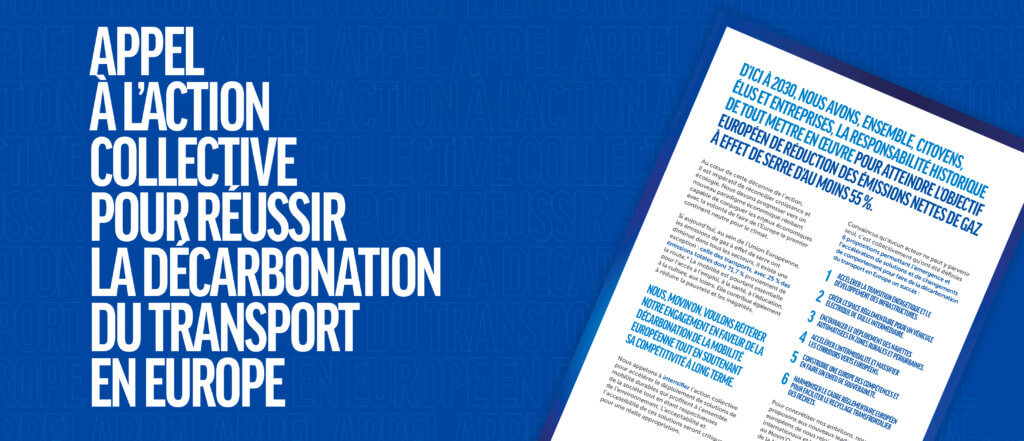
AT MOVIN’ON, WE ARE REAFFIRMING OUR COMMITMENT TO DECARBONISING EUROPEAN MOBILITY WHILE SUPPORTING ITS LONG-TERM COMPETITIVENESS.
We are calling for collective action to be stepped up in order to accelerate the deployment of sustainable mobility solutions that benefit society as a whole while protecting the environment. Public acceptance and accessibility will be critical to ensuring that these solutions are widely adopted. Convinced that no stakeholder can achieve this alone, we have collectively identified six proposals to foster and accelerate solutions and behaviour change, making the decarbonisation of transport in Europe a success:
If decarbonising freight transport is an urgent priority, a crucial question arises: across the public and private sectors, which energy or combination of energies should be used for which purpose?
The energy revolution is fundamentally transforming the business models of multimodal hubs, which must manage a diverse energy supply. Investments in energy infrastructure have a long-term impact. Our actions must take into account infrastructure ROI and synergies between different modes of transport, prioritising technological adaptability to ensure consistency, profitability and energy efficiency.
Safer or greener?
The European automotive market is currently facing two trends that conflict with the goals of decarbonised mobility. On the one hand, a safety policy aimed at achieving zero road deaths, requiring heavier equipment. On the other, a transition towards an all-electric market by 2035, structurally reinforcing this trend.
How can we reconcile environmental sustainability, economic considerations and mobility for all, across every region?
Technological innovation has a role to play: the potential of increasingly automated and connected vehicles must serve the public interest and deliver practical solutions for more sustainable and inclusive mobility. The shared automated shuttle—an electric, driverless form of public transport—is a good example: three out of four people in France* believe it will provide new or enhanced services, including at night and outside standard hours, enabling people to travel to medical appointments, work, places of study or leisure, and to do their shopping.
*Macif-Védécom 2024 Barometer, “French People and Automated Vehicles”
How can we strengthen connections between railways, inland waterways, maritime and land routes, and city centres, ports, airports and terminals across Europe?
The Movin’On impact coalition is working to strengthen the coherence and efficiency of a major intermodal transport network across our continent. Given their potential to reduce CO2 emissions, modal shifts are crucial to decarbonisation and climate action strategies:
Freight: Shifting freight from road to rail can reduce CO2 emissions by around 75% per tonne-kilometre. In regions where electricity comes mainly from renewable or low-carbon sources, such as hydropower, nuclear, wind or solar, the CO2 emissions associated with rail transport are even lower*.
Passengers: Shifting passengers from cars or air travel to rail can reduce CO2 emissions by around 50% to 90% per passenger-kilometre, depending on the initial mode of transport and the type of train used*.
*International Transport Forum: www.itf-oecd.org
What if mastering new technologies and business models such as circularity opened up new opportunities for Europe?
Greater professional adaptability for the industries of the future.
The challenge is to ensure that the right skills are available at the right time and in the right place by aligning education, vocational training and labour market needs across Europe.
How can we achieve this?
– By developing new skills through training.
– By supporting the transformation of the sectors concerned.
– By involving private and public stakeholders, particularly in education.
How can we give waste a new status to accelerate its treatment across Europe?
Today, around 95% of cars are recycled. In reality, the figure is 85% when the 10% attributed to “recovery” is excluded—the energy recovered by burning components. Of the 85% of materials that are recycled or reused, many undergo “downcycling”, meaning they are recycled for lower-quality uses.
The emergence of electric vehicles mechanically reduces the contribution of the use phase to a vehicle’s lifecycle carbon footprint, as the vehicle no longer consumes fossil fuels. Vehicle recycling therefore makes a greater contribution to the vehicle’s overall footprint and offers new prospects for transforming recycling—until now a largely “artisanal and local” activity—into a genuine European industry.
To turn our ambitions into reality, we invite Europe’s new political leaders to join our international experts and the Movin’On community at the Movin’On Summit, the International Sustainable Mobility Summit, taking place on 7 November 2024 in Brussels.
Together, we will identify the practical levers for action needed to decarbonise land transport in Europe.