Community for Impact
Why must the electrification of Europe’s automotive sector be based on a new generation of truly lightweight, efficient and affordable vehicles?
Download the discussion paper
Themes
Modes of transport
Build a Shared Vision
Prototype
Establish a European Regulatory Framework
Movin'On members



Contributing partners






A Pop Car feasibility demonstrator showing that an M1 electric vehicle can be lightweight, efficient, a four-seater, affordable and suited to everyday use.
An approach based on controlling vehicle mass: less battery, fewer raw materials, lower consumption, a smaller carbon footprint and a lower upfront cost.
Proof that a lighter electric car can remain useful, desirable and aligned with real mobility needs.
A basis for identifying the conditions required to move from concept to a real-world offering: production, financing, distribution, maintenance, insurance and public acceptance.
The first barrier is the spiral in which the European automotive market has become trapped: vehicles are getting larger, heavier, more powerful and more highly equipped—and therefore more expensive. This inflation directly weighs on electrification: the heavier the vehicle, the larger the battery it requires, the more critical raw materials it consumes, the greater its carbon footprint and the higher its purchase price. Electrifying vehicles designed around the standards of heavy internal-combustion cars is resulting in electric mobility that is too costly, too resource-intensive and not accessible enough.
The second barrier is the growing gap between the vehicles on offer and people’s actual usage patterns. A significant share of journeys consists of short, regular, local or peri-urban trips, for which lighter, more efficient and affordable vehicles would be sufficient. Yet the market continues to favour oversized cars designed to cover every possible use case. The challenge is therefore not simply to produce electric vehicles, but vehicles that are consistent with real mobility needs.
The third barrier is regulatory and industrial. The future M1E category is a useful step forward, but remains insufficient if it is based primarily on vehicle length. Length alone does not address mass, energy efficiency, carbon footprint, purchase cost, running costs or the ability to produce locally. To reverse the current trend, we need to recognise an approach based on efficient, resource-conscious design.
The working group’s challenge is therefore to remove several barriers at once: a market barrier, by moving beyond the race for greater weight and premium features; a regulatory barrier, by moving beyond a category defined solely by length; an industrial barrier, by structuring a European value chain; and an acceptance barrier, by showing that a lighter car can remain useful, safe, desirable and suited to essential everyday needs.
Make Pop Car concrete proof that an M1 electric vehicle can be lightweight, efficient, affordable and useful in everyday life.
Show that controlling vehicle mass can reduce battery size, consumption, carbon footprint, material requirements and final cost.
Shift the European debate beyond vehicle length alone towards an M1 VESA category based on mass, efficiency and accessibility.
Initial exploration of lightweight electric vehicles, everyday mobility needs and the limitations of the existing automotive offering.
Building the coalition and formalising the Pop Car concept around a lighter, more efficient four-seat M1 electric car, suited to everyday journeys and designed to remain affordable.
Initial feasibility studies, including technical, economic and usage simulations to test the Pop Car equation: mass, range, consumption, upfront cost, carbon footprint and acceptance.
Consolidating the Pop Car demonstrator to make the feasibility of a lightweight, efficient and affordable electric vehicle tangible, and to identify the conditions required to move from concept to a real-world offering.
Further work on the conditions for scaling, with the stakeholders concerned: design, the European value chain, financing, distribution, insurance, maintenance, safety, regulation and user demand.
Next step: seeking industrial and institutional partners to turn the feasibility proof into a development pathway.
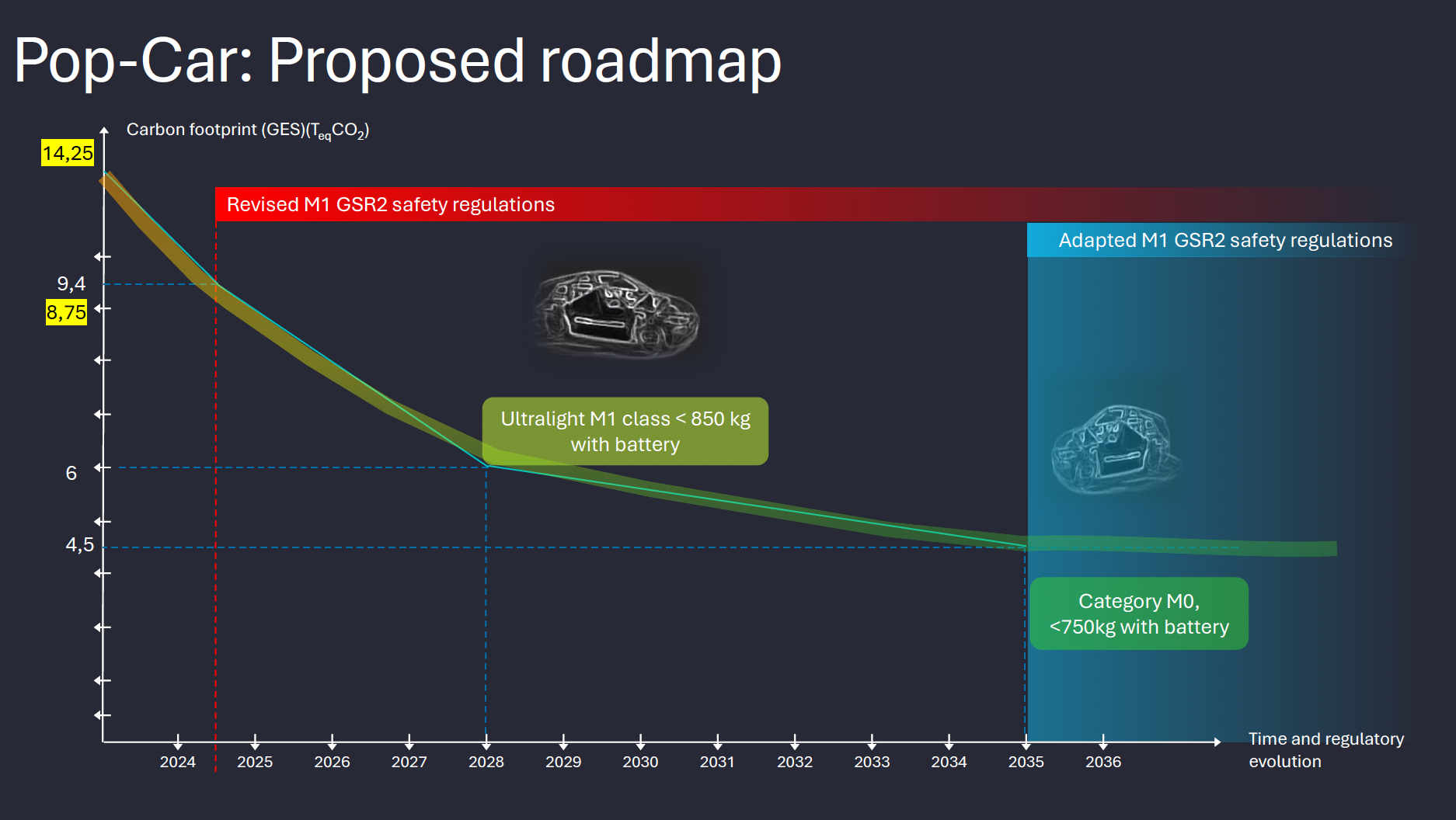
Reduce the actual environmental footprint of electric mobility across its entire life cycle by addressing vehicle weight, not just use-phase emissions.
Make lightweight electric vehicles a strategic European advantage by reducing dependence on imported raw materials and strengthening Europe’s industrial capabilities, particularly through frugal innovation and support for SMEs.